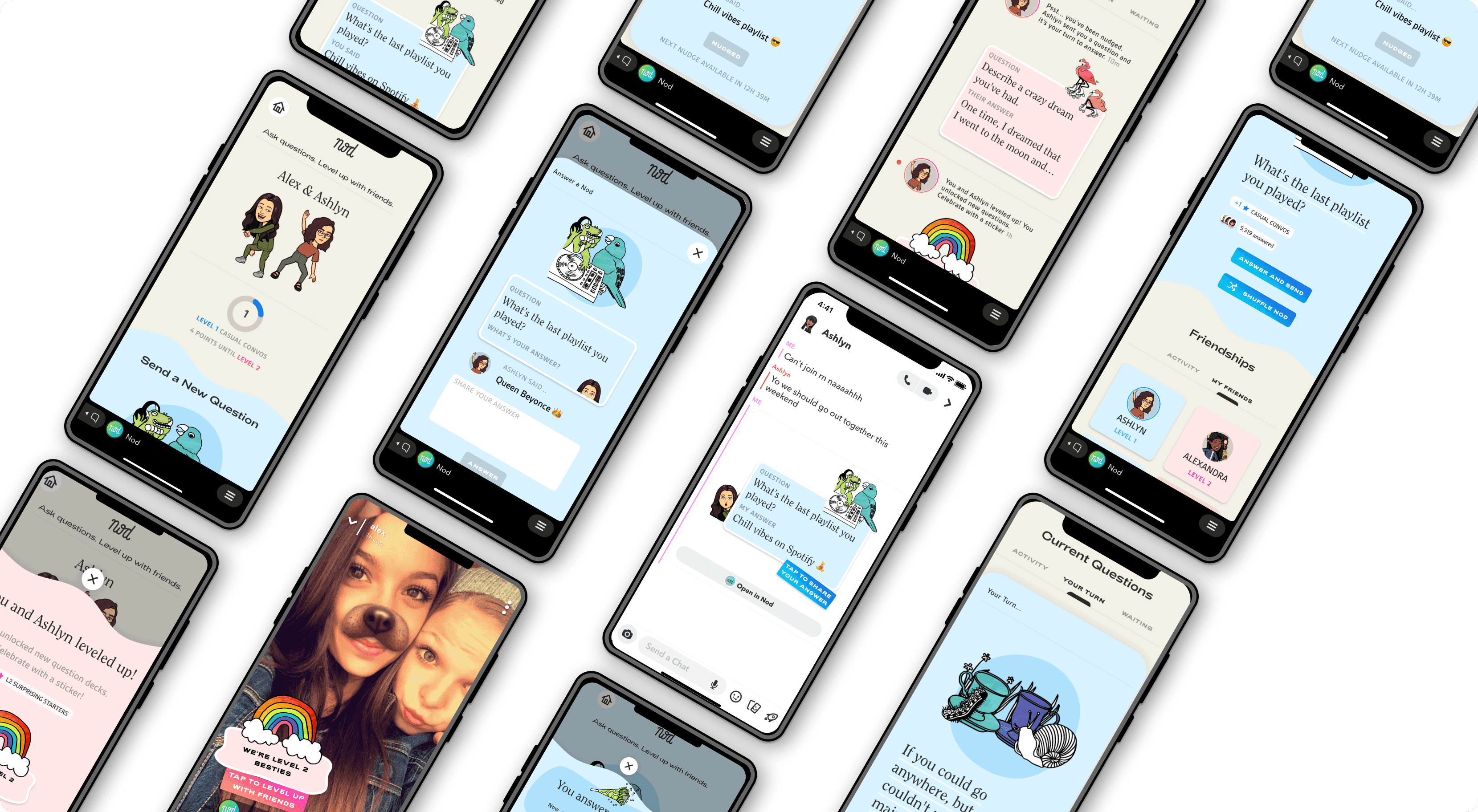
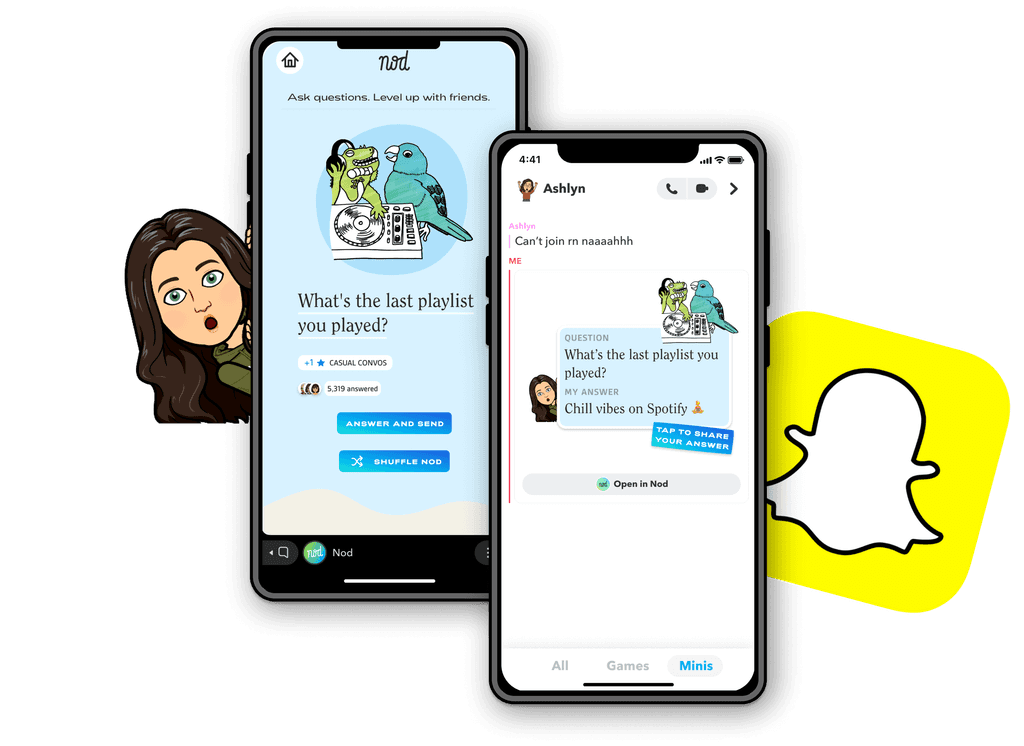
The Nod Mini helps Snapchat users level up their friendships through a gamified conversation experience that draws on the science of social connection.
Role:
Product Design
Project Focus:
0-1 Concept & Hand-Off
Duration:
4 weeks, Summer 2022
What is the Nod App?
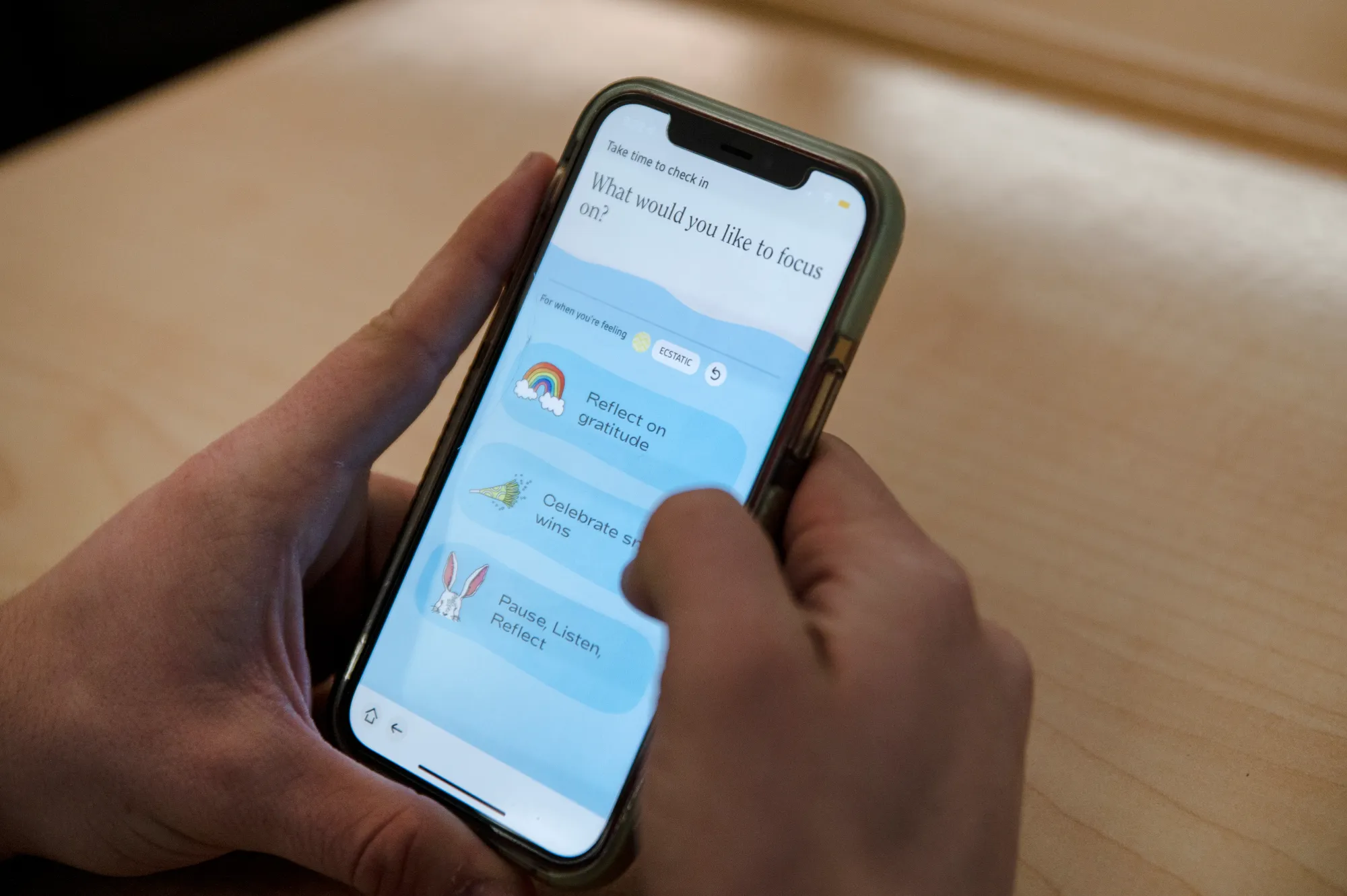
Nod is a mobile app co-developed by Hopelab and Grit Digital Health that helps college students build stronger social connections, from shared interests to deeper conversations. The app is grounded in the science of social connection and has demonstrated efficacy in reducing loneliness among at-risk students.
Project Details
I joined after initial research and early product exploration had been completed. My responsibility was to take the Nod Mini from concept to a 0 → 1, developer-ready experience, delivering a final prototype and clear design requirements in collaboration with Snapchat partners.
Lead Product Designer representing Grit Digital Health. Collaborated with Product Managers and Developers from the Snap Mini team.
Initial research and product development had occurred in Spring 2022, prior to my involvement on the project. I stepped in and was tasked with taking the Nod Mini concept from 0 to 1 with a final prototype and design ready requirements
I built on existing research and early concepts to define and deliver the core Nod Mini experience, focusing on clarity, engagement, and platform integration. My work centered on three key areas:
Deepening connection through gamification
Driving return engagement with notifications
Designing seamless, multi-surface entry points into Nod Mini
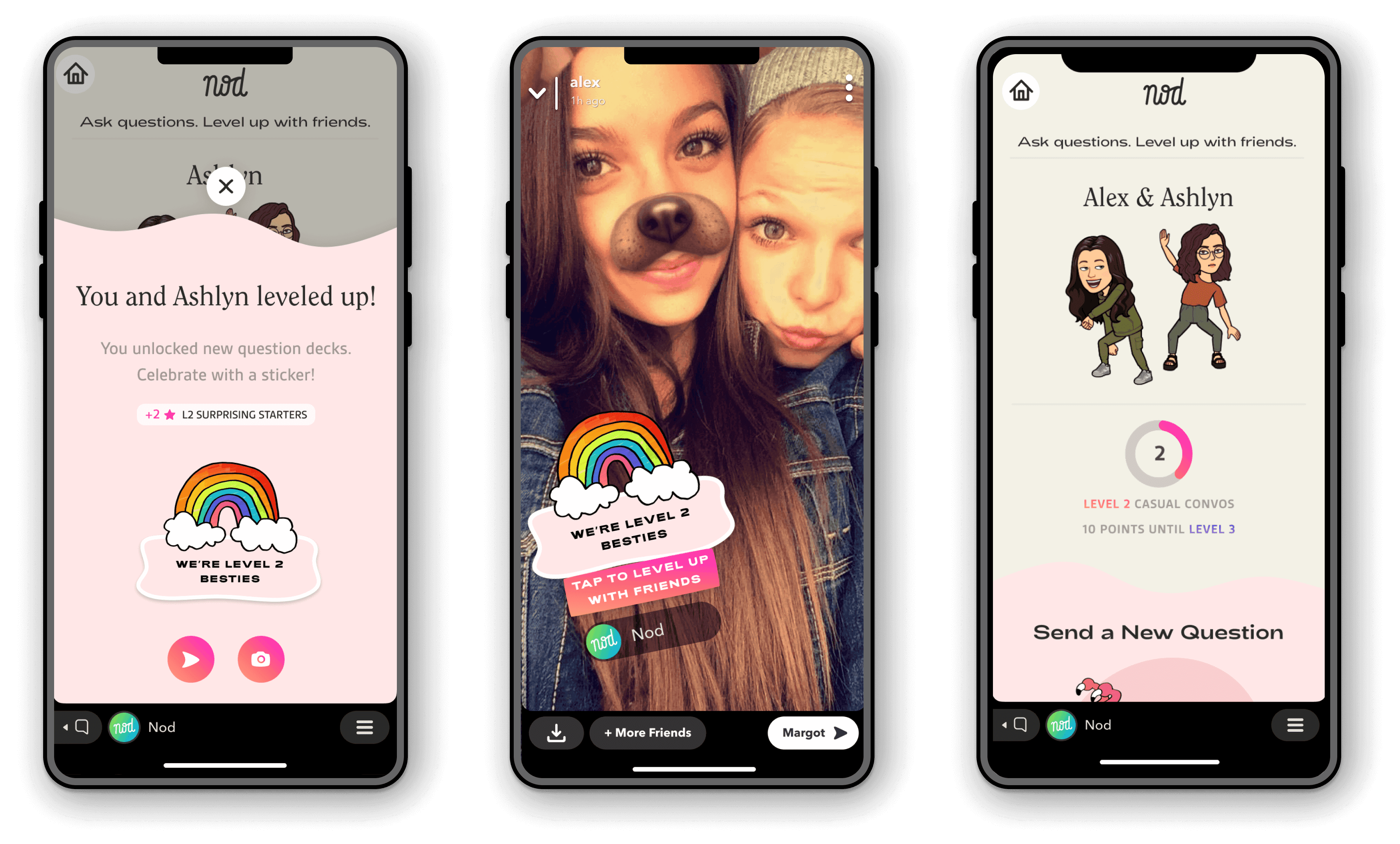
How might we introduce familiar Snapchat native gamification patterns into Nod Mini so users can clearly track progress, feel rewarded, and stay motivated to continue engaging?
Goal: Strengthen social connection between friends by encouraging repeated, meaningful interactions.
Strategy: Use clear progression and shareable rewards to reinforce momentum and unlock Nod’s science-backed benefits, including reduced loneliness and depression.
Design and integrate core gamification mechanics (levels, points, and progress visibility) to motivate continued participation and deepen connection.
→ Shareable “Level Up” Rewards
Designed celebratory level-up screens and Snap-ready stickers that mark friendship milestones. As users progress from light to deeper self-disclosure questions, shareable rewards increase visibility and perceived value of leveling up.
→ Progress Tracking
Added clear progress indicators across key surfaces (home and friendship views) so users can quickly understand their current level, growth over time, and points needed to reach the next milestone.
→ Social Light Features
Introduced subtle activity signals in the feed to provide social proof, reinforce participation, and normalize continued engagement without adding social pressure.
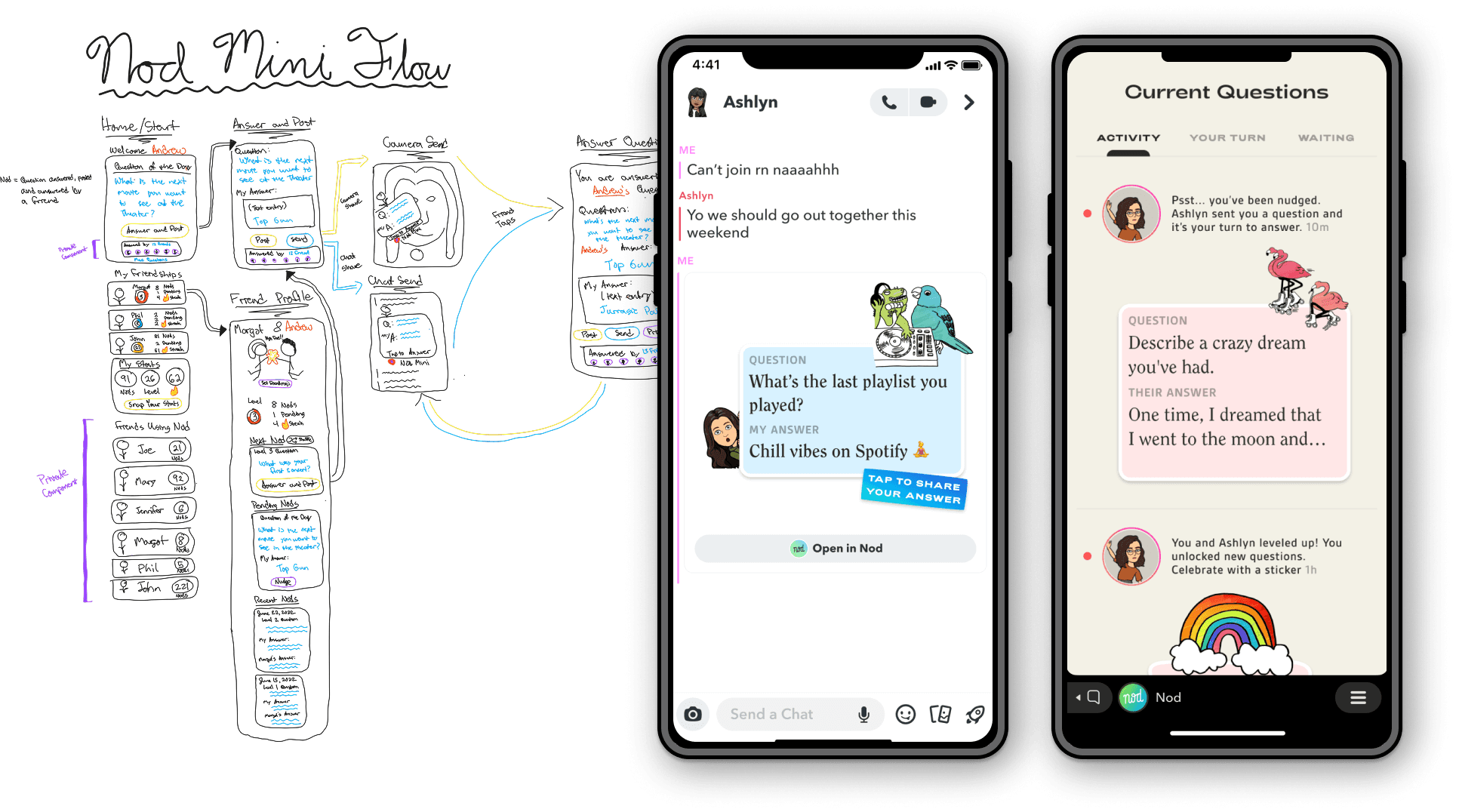
How might we leverage familiar Snapchat notification patterns to surface meaningful activity, prompt timely responses, and encourage users to return to Nod Mini?
Goal: Increase return engagement and unblock stalled conversations within one-on-one friendships.
Strategy: Use clear, contextual notifications and lightweight social nudges to reinforce the Q&A loop without creating notification fatigue.
→ Familiar patterns
Applied proven social behaviors like activity feeds, notification badges, and app-level alerts—to ensure notifications felt intuitive, timely, and actionable.
→ Activity feed:
Designed an in-mini activity feed to surface recent interactions and highlight outstanding actions needed to earn points and progress a friendship.
→ Nudges
Introduced lightweight “nudge” notifications that allow users to remind friends when a question is awaiting a response, helping unblock stalled conversations without social pressure.
→ 70% of notifications result in a Nod Mini launch
→ Reduced number of unanswered questions beyond 24 hours
→ Increased DAU for Nod Mini launches
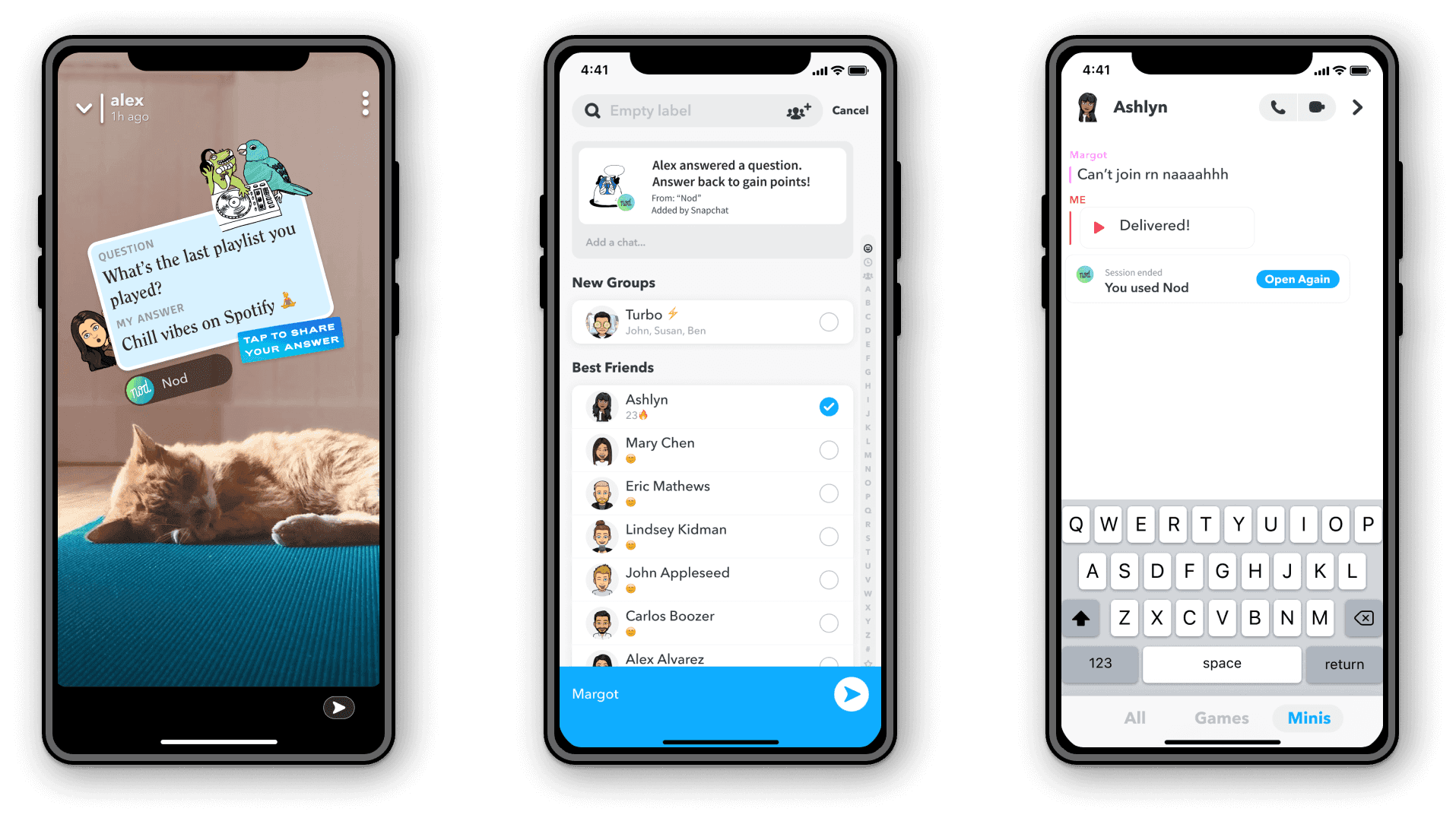
How might we design around Snap Mini’s unique entry points to create a seamless transition between the Snapchat platform and the Nod Mini experience?
Goal: Reduce friction to entry and make Nod Mini accessible wherever users naturally interact.
Strategy: Leverage Snapchat-native surfaces and consistent system feedback so users can enter Nod Mini from multiple contexts without losing orientation.
After researching Snap Mini documentation and platform constraints, I designed a system that supports multiple entry paths while maintaining a consistent experience.
→ Dynamic stickers
Built to re-engage users and drive return traffic into Nod
→ Chat and camera notifications
To support contextual re-entry from active conversations
→ In-app notifications
Surfaced through a live activity feed to guide users back into the Mini
To align teams and reduce implementation risk, I documented each entry point through interactive prototypes, helping product, design, and engineering teams understand system behavior and edge cases.
This project was ultimately discontinued during development due to industry-wide layoffs in Fall 2022. While it was disappointing to see the work not launch, the experience reinforced the realities of building products within evolving organizational and market constraints.
Despite the outcome, I’m proud of the vision we created, to help millions of users deepen one-on-one social connections, and the quality of the work produced across design, product, and engineering.
What I Learned
Working alongside teams at Hopelab and Snapchat was a formative experience. The project strengthened my ability to design within complex platforms, collaborate across organizations, and advocate for products grounded in social impact. It further reinforced my commitment to building digital experiences that meaningfully support human connection.